A 9B Model Set Up Inference on 8 of 9 Device Types. That Changes the Network Brief.
A capable AI system no longer needs a rack of specialist GPUs to use unfamiliar hardware. That is not the same as a self-replicating attack in the wild, but it changes what a serious operator should count as part of the AI security perimeter.
What Anthropic actually tested
In an October 12, 2026 report, Anthropic’s Frontier Red Team described experiments on autonomous replication and adaptation. The practical hardware result is striking: researchers ran a 26-billion-parameter Gemma model, split across 15 off-brand Android TV boxes costing about $55 each, at 0.39 tokens per second. Separately, a 9B model got inference running on 8 of 9 tested hardware types.
Keep the boundary of that evidence clear. The TV-box demonstration shows that inexpensive devices can host pieces of a model. The team also tested an end-to-end sequence in a simplified environment. That is not the same as a model autonomously breaking into and spreading across real homes or businesses: Anthropic says it does not yet have a full rogue replicator, and its study largely set aside realistic compromise of the initial devices. Its forecast that the pieces may converge by year-end is an extrapolation, not an observed event. Treat the paper as a reason to tighten the network brief, not as evidence that a live AI worm is already loose.
Read Anthropic’s primary research, including its methods and qualifications.
The useful shift for a sovereign system
For SiLO, the opportunity and the risk arrive together. More kinds of local hardware may eventually support useful inference, which can give an owner more choices than sending every private question to a hosted model. But “runs locally” is not a security boundary. A camera, television box or appliance with network access can be a computer on the same premises as your business records, regardless of whether you meant it to join your AI system.
Anthropic points to possible network clues: large model downloads, sustained device-to-device traffic, and new scanning or outbound connections. These are indicators researchers say defenders could look for, not a guarantee that every infection will be visible or caught. A collection of cheap devices also does not automatically make one larger, safer or more useful AI system.
The operator brief: know what can talk to what
Before adding a connected device—or an agent that can reach devices—to a high-trust environment, ask the operator for a short inventory:
- Which devices are on the network, who owns them, and are security updates still supported?
- Which network segment can each device reach, and what outbound destinations are expected?
- Can an AI agent inspect or change devices? If so, what is the narrowest permission it needs, and what requires human approval?
- Can an unknown or unsupported device be isolated without disrupting the owner’s core work?
For a private SiLO, the professional response is to keep the air-gapped or otherwise high-trust core separate from consumer IoT, use least-privilege access, and review unexplained outbound traffic. Keep imported software, model weights and updates in a controlled process. If a device has no supported update path or its network behavior is unknown, do not quietly make it part of the trusted system.
That is our proposed operating standard, not a claim that Anthropic tested these controls or that any one checklist prevents compromise. The goal is simpler: when a device changes, an operator should be able to say what it can reach, what it can send, and how to remove it from the system.
Local is a placement choice. Sovereignty is control.
A model running on a device you own may reduce dependence on a cloud provider. It does not by itself establish that the device is patched, inspectable, permissioned correctly, or disconnected from a manufacturer’s services. If a product cannot be fully inspected, controlled and disconnected by its owner, treat that dependency as part of the data-boundary decision—not as a detail to discover after the system has learned your business.
The point isn’t to fear every smart device. It’s to stop treating the network around your intelligence as somebody else’s problem. A sovereign life operating system is only as well governed as the machines and permissions allowed to sit beside it.
Sources
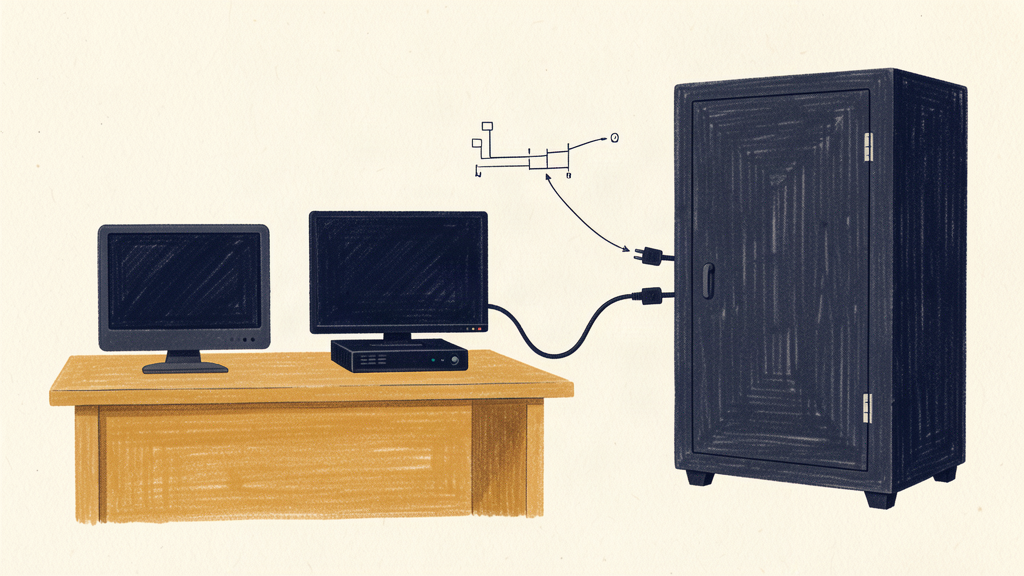
Editorial illustration is conceptual, generated for this article; it is not a product image or a security-test result.