Before You Buy a Robot, Simulate One Real Job
SiLO perspective: this is an operator decision brief, not an independent product review.
A polished robot demo can make a purchase feel obvious. It rarely answers the questions that matter to an operator: can this machine do our actual job, under our constraints, and what will it need to know about our business to do it? NVIDIA’s October 21 announcement of SimReady Central gives robotics teams a more reusable starting point for testing those questions in simulation. It does not make a simulation a safety case or a deployment plan.
What changed
NVIDIA and Hugging Face announced SimReady Central, a library of more than 2,000 OpenUSD assets prepared for simulation workflows. The examples range from robot arms and grippers to warehouse equipment, racks and cooling infrastructure. Unlike a plain 3D model, a SimReady asset can include properties such as collision geometry, mass, friction, joint limits and semantic labels. Those details can save teams from rebuilding basic scene components before they test a workflow.
The important qualifier is “for a defined use case.” SimReady profiles describe which capabilities an asset needs for a particular kind of simulation. NVIDIA’s post describes the library as free and ungated. At my October 23 check, however, the Hugging Face dataset page labelled SimReady Central alpha and said visitors must agree to share their Hugging Face information to access files and content. That page also tells users to review each asset’s license, profile and validation evidence, and to use a registered revision when reproducibility matters. Treat access and licensing as facts to check, not assumptions based on the word “open.”
The SiLO read: test the job before you buy the machine
For a sovereign AI life operating system, physical agents will eventually be another kind of tool. They may move objects or operate equipment, but they can also introduce cameras, microphones, remote support, update channels and new places where private context could travel. A simulation library can help an operator explore a bounded task before a robot is connected to a real environment or to a SiLO.
That is the opportunity. A repeatable scene gives your team something concrete to inspect and compare. It may help expose a bad layout or a missing assumption earlier. It does not prove that the physical robot will behave the same way. Nor does “open” mean that every asset, runtime, robot or data path is owner-controlled. OpenUSD is a scene format; it is not a guarantee of safety, privacy or independence from a hosted service.
There is a practical access question here, too. The announcement’s “ungated” description and the current dataset page’s account-and-information-sharing condition do not say the same thing. That is not proof that private files are collected. It is a reason to inspect the actual terms and destinations before a team uses an account or uploads anything.
A brief to delegate
You should not need to spend an afternoon assembling a digital factory just to decide whether a robot pilot deserves attention. Ask the robotics lead or qualified integrator for a one-page readout on one real, bounded task:
- Job and payoff: What task is being tested, what result would make it worth pursuing, and what assumptions are outside the simulation?
- Reproducibility: Which asset revisions, licenses, profiles, software versions and scene files were used? Can another operator reopen the same test and understand its limits?
- Data boundary: What account, service or network is required? What information leaves the approved environment? Keep proprietary floor plans, schedules, recordings and personal context out of public test uploads. If a destination or retention term is unclear, mark it unresolved.
- Safety and handoff: What must a qualified machinery-safety professional assess before any physical trial? Can the team recover the scene, results, source links and decision record without relying on one vendor account?
For an air-gapped SiLO, keep live robot coordination outside the isolated core. Bring in reviewed assets through a controlled process, and share only the minimum task context with any connected system. Simulation can sharpen the buying question; it cannot replace an independent assessment of physical safety or actual data custody.
The useful next step is not “buy the humanoid.” It is to make the proposed job, evidence and data boundary clear enough that you can decide quickly whether a pilot earns a place on your agenda. Sovereign AI should extend your reach without taking command of your information.
Sources
- NVIDIA Newsroom, “NVIDIA Advances Isaac Platform for General-Purpose Robotics,” October 21, 2026
- Hugging Face, “Announcing SimReady Central,” October 21, 2026
- Hugging Face dataset card and access notice, checked October 23, 2026
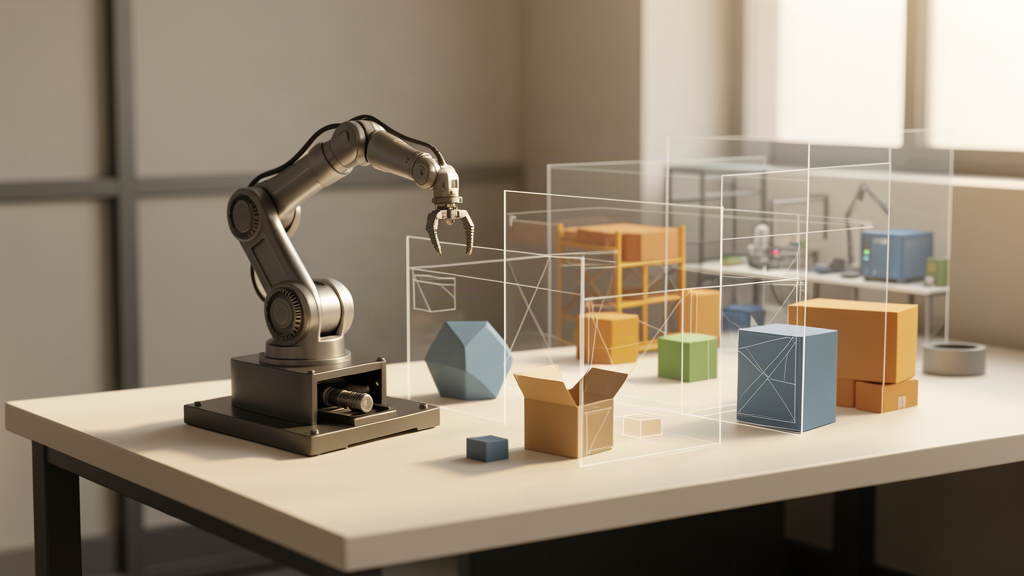
Illustration is conceptual editorial art, not a depiction or validation of SimReady Central or a specific robot.